Tuesday, December 1, 2009
A Possible Home for the Murals!
Last night Art Knight addressed city council to clarify plans for the new art gallery at River Landing. Mr. Knight is Chair of the Mendel Art Gallery Board of Trustees. When asked how the new gallery would address honouring Fred Mendel Mr. Knight explained an intention to build a 'Mendel Salon' in the gallery to house our Perehudoff murals!


Monday, November 2, 2009
Removing the Murals

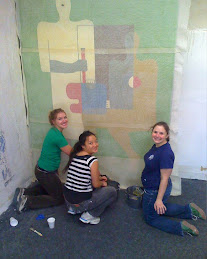
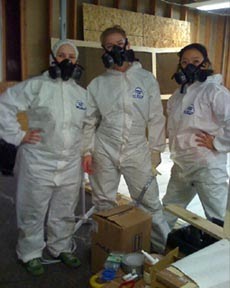
The above photo shows the restoration team left to right: Jillian Cyca, Angela Christie, Ian Hodkinson, Julie Oh and Brenda Lee Smith. Brenda is a conservator in Regina and a former student of Ian's. Jillian, Angela, and Julie are U of S graduates involved in the arts. The work began on November 2 and is scheduled to be completed by November 30.
WEEK 1
Week one was spent preparing the murals for removal and familiarizing the assistants with the process. The process is called the "strappo" method. It involves painting glue (in this case Nova Scotia codfish glue) over the surface of the mural, embedding two layers of fine canvas into the glue, then letting it dry until the glue is bonded to the mural surface. The canvas is then peeled off the wall, removing the painted surface. Next, the back of the canvas is painted with a primer before applying fiberglass, aluminum honeycomb, and a wood frame to give it structure. Finally, the water based glue and canvas are washed off the front, revealing the original image. This method was successfully used to restore a small mural on an interior wall. We hope that the same method will work equally well with the other murals, however the plaster appears to be loose on some exterior brick walls and there is a risk that it could break off. All work will be performed in a large area outside the murals room which has been outfitted as a workshop, thanks to the generous help of Maple Leaf Foods.
WEEK 2
On Monday two murals were successfully removed: the guitar and a minor image. On Wednesday the largest image was removed. This was a high-risk mural since it was on an exterior wall and Ian had worried that the plaster could break off. By Friday only four images remained on the wall. While removing the images from the walls has gone well, the process of finishing them with a fiberglass backing is proving to be a long and difficult multi-step process. Every step has presented challenges which have required ingenuity and a great deal of experimentation. Ian explains that he is unaware that anyone has ever restored an acrylic painting before, so we are breaking new ground here in Saskatoon.
WEEKS 3 and 4
All the images were successfully stripped from the walls. The mayor and CTV News were there to witness the removal of the final image. The mayor even agreed to climb up onto the scaffold to assist rolling the last image onto a cardboard roll. The spent the remainder of November building backing panels for the murals, however there was not enough time to mount all the images onto the panels in a presentable format. Ian returned to Ontario on December 1.
NEXT STEP
Ian will return in April to complete the job. He took two blank wall samples back to Ontario and will spend time this winter experimenting on them to find an effective way to mount them onto the fiberglass panels. One possible method may involve using a vacuum to force the canvas flat onto the panels. Another option is to use heat activated epoxy impregnated with 'micro balloons' to minimize the fluidity of the epoxy. We are currently working to find a new workshop for him, since the Maple Leaf building will have been demolished by then. We are hoping Angela, Jillian and Julie will also be available to help again in April. Their contribution throughout November was crucial and also made the project much more enjoyable.
Tuesday, September 29, 2009
City Council and Maple Leaf Foods Contribute $25,000 Each
Saskatoon City Council last night voted unanimously to provide $25,000 toward the removal and restoration of the murals. Combined with $25,000 already committed by Maple Leaf Foods, we now require only $30,000. We are now beginning a campaign to raise those funds. Excess funds, if any, will be used to fund "Mendel's Murals," a group dedicated to funding new public murals in Saskatoon, in the spirit of Fred Mendel's support of the arts. Ian Hodkinson is scheduled to visit October 20th to perform some preparatory work and interview possible assistants. The removal and restoration will be completed on-site in November.
The Mendel Art Gallery and the University are in talks to determine how the murals will be displayed. Our immediate hope is that the art will be broadly accessible. Over the long term, we hope that the murals can be permanently exhibited in a dedicated room complete with windows and doors configured as the room stands today. This is important because Perehudoff did not create eleven separate murals, but rather he treated the entire room was as a single artwork. Hodkinson suggested that ideally a reconstructed room might serve the same purpose as the original room, which was a seating area in an art gallery. The opportunity to build such a room might arise at a new gallery at River Landing, at the existing Mendel Building, or at a new Performing Arts Centre on campus.
The Mendel Art Gallery and the University are in talks to determine how the murals will be displayed. Our immediate hope is that the art will be broadly accessible. Over the long term, we hope that the murals can be permanently exhibited in a dedicated room complete with windows and doors configured as the room stands today. This is important because Perehudoff did not create eleven separate murals, but rather he treated the entire room was as a single artwork. Hodkinson suggested that ideally a reconstructed room might serve the same purpose as the original room, which was a seating area in an art gallery. The opportunity to build such a room might arise at a new gallery at River Landing, at the existing Mendel Building, or at a new Performing Arts Centre on campus.
Sunday, August 9, 2009
One of the Murals Has Been Successfully Removed
One of the eleven murals was successfully removed on August 5th by art conservator Ian Hodkinson. To everyone's surprise, the process was relatively simple. If the remaining ten images were painted with the same materials, as we expect, then this experiment shows that it is very likely that they also can be elegantly removed using the same method. Hodkinson used the "Strappo" method with a special glue he discovered made from Nova Scotia cod fish. Using his method, the images were literally peeled off the wall, leaving the the plaster intact and affixed to the original wall structure. The section he removed was one of the three minor images measuring 32 inches by 36 inches. Ian described the quality of the image he removed as "very good." We hope to bring Ian back to Saskatoon to complete the project in November, provided that funds can be raised by that time.

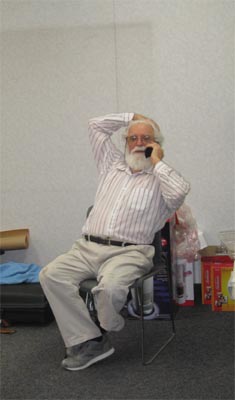
Ian Hodkinson holding the mural he removed.

Ian Hodkinson holding the mural he removed.
Friday, July 17, 2009
Preservation Study to be Performed by Canada's Premier Conservator of Murals and Frescoes.
On August 4, Ian Hodkinson will fly to Saskatoon for a four-day visit to study the murals. Professor Hodkinson's resume is very impressive, as former Head of the Conservation Centre for the National Trust for Scotland, Head of the Restoration and Conservation Laboratories of the National Gallery of Canada and Director of the Master of Art Conservation Program at Queen's University. His achievements include restoration of medieval and renaissance murals and painted ceilings in Scotland, transfer of the historic Croscup Room from Nova Scotia to the National Gallery of Canada, consultation on mural restoration at Trinity Church in Boston, and restoration of the Constantino Brumidi frescoes in the Senate Appropriations Committee Room in the Capitol Building in Washington D.C.
We are honoured that Mr. Hodkinson has agreed to assist us with this project. We are also grateful for his generous offer to contribute the report free of charge. His report will discuss the feasibility and methodology for saving the murals. It will also provide guidance for more rudimentary preservation methods which might be employed in the event that funding is not available in time for a complete professional removal of the art. The costs for his visit have been generously underwritten by the University of Saskatchewan and his lodging provided thanks to the Delta Bessborough.
We are honoured that Mr. Hodkinson has agreed to assist us with this project. We are also grateful for his generous offer to contribute the report free of charge. His report will discuss the feasibility and methodology for saving the murals. It will also provide guidance for more rudimentary preservation methods which might be employed in the event that funding is not available in time for a complete professional removal of the art. The costs for his visit have been generously underwritten by the University of Saskatchewan and his lodging provided thanks to the Delta Bessborough.
Eminent Art Historian Descibes Murals as "Very Significant"
On Wednesday, July 8, the murals were visited by eminent historian, critic, and curator Roald Nasgaard. Nasgaard authored "Abstract Painting in Canada" and is considered one of Canada's leading experts on the subject. His resume includes many years as Chief Curator at the Art Gallery of Ontario and as Chair of the Art Department at Florida State University. Nasgaard was very impressed with the murals describing their role in Canadian art history as "very significant." He noted that the murals are one of Canada's few, if not our only remaining example, of Purist Cubist art from the period. Also in attendance were Perehudoff's wife, Dorothy Knowles, daughter Catherine, Lynn Earle, and Vince Varga, director of the Mendel Art Gallery.
Thursday, July 2, 2009
The History of the Murals
The murals were completed in 1953 by William Perehudoff at a time before his work was well-known. His talent, however, did not escape the attention of Fred Mendel, an avid art lover. Mendel was a Jewish immigrant who made Saskatoon his home after fleeing the holocaust in Nazi Germany. He was also the founder of Intercontinental Packers, the company where Perehudoff worked doing manual labour. In 1953, Mendel was already widely respected for his fairness, integrity, and great business skill. He was also known for the respect and compassion with which he treated his many employees. Mendel hired Perehudoff to make art for his factory in the interest of making his meat packing plant more hospitable for his employees. He also likely wished to support a talented young artist. Perehudoff made several works for Mendel in the 1950's, among them were these murals which were painted directly onto the plaster walls of Mendel's office. In later years Fred Mendel became one of Saskatoon's foremost philanthropists, and the founder of the Mendel Art Gallery.
Perehudoff went on to become one of Canada's foremost artists. He is regarded by many as the heir to Jack Bush as Canada's most important colour field painter. In 1963, Clement Greenberg, arguably the world's most respected art critic at that time, characterized art from Saskatchewan as "New York's only competition." William Perehudoff's art was likely among the work Greenberg was describing.
In 2008, Mendel's meat packing plant became scheduled for demolition to make way for a new freeway. The cost of professionally removing the murals from the plant seemed prohibitive and no organization had the money to do the work. When it became known that the Perehudoff murals would be destroyed in the demolition, several concerned citizens organized a grassroots campaign to raise money and volunteers to save the art. While it seemed impossible to afford a complete restoration, organizers hoped that significant portions of the art could be saved for less money using ingenuity and volunteers from all walks of life.


Wednesday, July 1, 2009
Fred Mendel’s Other Gallery (Printed in Sunday Sun - Aug 16, 2009)
Fred Mendel is well-known for his important role in founding our art gallery which bears his name. When the Mendel Art Gallery was built, he paid nearly one-third of the construction costs and donated thirteen important paintings. However, his contribution to our city goes much deeper and much of his colourful personal history is not widely known.
Before moving to Canada, he was a self-made millionaire who dined with generals, and was frequently entertained by the greatest performers, writers and artists of Berlin, Vienna, and Paris. As a Jewish German he lived a life of adventure, evading the Nazis for many years until he was finally forced to flee. He counted sixteen occasions where the Nazis might have killed him. He credited miracles for some of his escapes, like the occasion when, after having escaped to Canada, he made a dangerous journey back to Hungary in 1940 to attempt to bring money back to support his new meat packing plant in Saskatoon. He was taken into custody by the police there and would likely have been jailed, but for the last-minute intervention of his well-connected friends in the horse racing world. He even returned to Hungary once, ignoring the pleas of his family, just to see one of his horses run an important race. He was nearly caught. On one occasion he came face to face with Adolph Hitler. Fourteen of Mendel’s close relatives were murdered by the Nazis, including his sister, her family, and his mother-in-law. His own wife and two daughters only barely escaped capture in Vienna.
In 1939 Mendel moved to Canada, selecting Saskatoon because, as he stated, “I am more at home … in smaller places, with average people rather than ‘big shots.’” He purchased a run-down former automobile factory on 11th Street West. The building had few prospects for re-use and the sellers were surprised to unload it. Mendel, however, was a self-described “eternal optimist” and believed he could refit it as a meat packing plant, as he had done several times before in Europe. Mendel had been forced to abandon most of his wealth in Europe and invested almost all his remaining money refurbishing the old building. One of his improvements was to build a comfortable living quarters in the upstairs of the factory where his family would live.
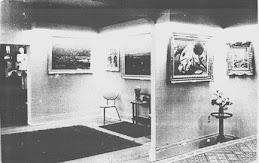
The early years were very difficult for Intercontinental Packers, his new business. Even Mendel was doubtful that it would survive, but after two years the prospects improved and Mendel moved his family out of the factory and into his house on Saskatchewan Crescent West. His wife Claire redecorated their former living quarters in the factory as an upstairs suite for entertaining business guests and, more importantly, as a gallery to exhibit Mendel’s growing collection of art. The rooms were fitted with thick rugs, lush drapes, a gramophone, and above all many great paintings. His art collection was described as one of the most important in North America and included works by Franz Marc, Pissarro, Renoir, Chagall, Emily Carr, and members of the “Group of Seven”, among many others. Alongside these masters he hung works by local artists who he encouraged. The room always had fresh cut flowers and the doors were never locked. The suite became a busy place, the center of the art world in Saskatoon-- an art salon in the European tradition. It was a place where young artists could come to see a caliber of art which would be envied in larger cities like Toronto and Montreal. Here they might meet master artists flown in by Mendel from Europe, or discuss art with Mendel and his daughter Eva who actively cultivated relationships with the local artists. Lavish New Year’s parties were held each year in the large cafeteria. Mendel, a humble and generous man, would wander among the guests asking “Are you happy? Is there anything I can do for you?”
One man working at Mendel’s factory then was the soft-spoken William Perehudoff. Perehudoff was a young farmer from Lanigan who did art in his spare time. Mendel happened to see one of his works, a sketch the artist called “Cow Barn.” Mendel bought it for $15. It may have been the first work sold by Perehudoff, now a member of the Order of Canada. With encouragement, Perehudoff left Saskatchewan to study under Jean Charlot in Colorado, then under Ozenfant in New York. When he returned in 1953 Mendel hired him to create frescoes on the plaster walls of the reception area in his upstairs gallery. The frescoes remain there today.
The effect of Mendel’s ‘salon’ on Saskatoon’s art world should not be underestimated. In the 1960’s Saskatchewan was recognized as the center of an important art movement. Clement Greenberg, who was arguably the world's most influential art critic at that time, characterized art from Saskatchewan as "New York's only competition." William Perehudoff's art was central among the work Greenberg was describing. Perehudoff had become one of Canada's foremost colour field painters and it seems likely Perehudoff, among other artists, owe some of their success to their formative years at Mendel’s upstairs gallery.
Fred Mendel had an amazing life of adventure and sadness. We are fortunate that he finally settled here and truly adopted Saskatoon as his home. He thrived wherever he lived and Saskatoon was no exception. His son-in-law, Cameron Mitchell, described Mendel, who was only five feet, one inch tall as “barely large enough to fit his giant heart.” He put all his heart into Saskatoon. He wrote that “Business is not enough if it means only the accumulation of money.” We continue to enjoy the legacy of his generosity, not just through our gallery in his name, but also because of the window he opened for us to Europe’s highest arts and ideas.

Subscribe to:
Posts (Atom)